


Table of Contents
- Why Pink Acrylic Powder Deserves a Spot in Your Kit
- Sheer vs Opaque Pink Acrylic: Which Finish Do You Need?
- How to Apply Pink Acrylic Powder for a Smooth, Lasting Set
- The Best Pink Acrylic Powder for Beginners: What to Look For
- Matching Pink Powder to Skin Tones and Nail Shapes
- Troubleshooting Common Pink Powder Problems
- Caring for Your Pink Acrylics to Extend Wear
- Final Thoughts on Choosing Your Pink Powder
- Frequently Asked Questions
Last Updated: September 10, 2026
Why Pink Acrylic Powder Deserves a Spot in Your Kit
Pink acrylic powder is the workhorse of professional nail enhancement, yet it often gets treated as an afterthought next to bolder pigments. This guide from JBB Nail’D It breaks down how to choose and apply pink powder for results that look natural and last through weeks of wear.
Most nail techs reach for pink powder to extend the nail bed visually or create a natural-looking base. Pigment density and consistency vary between brands, affecting self-leveling and adhesion. A quality pink powder should mix smoothly with monomer and form a bead that stays workable without running.
Pink isn't a single color, it's a spectrum from sheer formulations for overlays to opaque shades for full coverage. The wrong finish can leave nails looking chalky or artificial, regardless of application technique.
Sheer vs Opaque Pink Acrylic: Which Finish Do You Need?
Sheer pink acrylic powder creates a translucent enhancement that lets the natural nail show through, while opaque pink provides full coverage. The choice comes down to the service and the client's desired outcome.
For overlays, sheer pink mimics the healthy flush of a natural nail bed and works well beneath a white French tip. Opaque formulas suit clients with discolored nails or those wanting a solid pink set without extra polish.
Sheer powders require thinner beads to avoid bulk, while opaque formulas tolerate more sculpting. Beginners should start with sheer pink for overlays before tackling full opaque sets.
How to Apply Pink Acrylic Powder for a Smooth, Lasting Set
Applying pink acrylic powder follows the same steps as any acrylic enhancement, but the finish demands attention to bead size and placement:
- Prep the nail properly. Push back cuticles, gently buff the nail plate, and apply a dehydrator followed by an acid-free primer. Skipping this step is the most common cause of premature lifting.
- Load your brush correctly. Dip the brush in monomer, wipe one side, then pick up a bead of pink powder. The bead should be glossy and compact, not wet or runny.
- Place the bead near the cuticle. Press the bead slightly toward the cuticle area, then gently pat it into place rather than brushing it across the nail.
- Shape while workable. Use light pressure to sculpt the pink powder across the nail bed, keeping the thickness even before it begins to cure.
- Refine and finish. Once the acrylic sets, file and buff to your desired shape and smoothness.
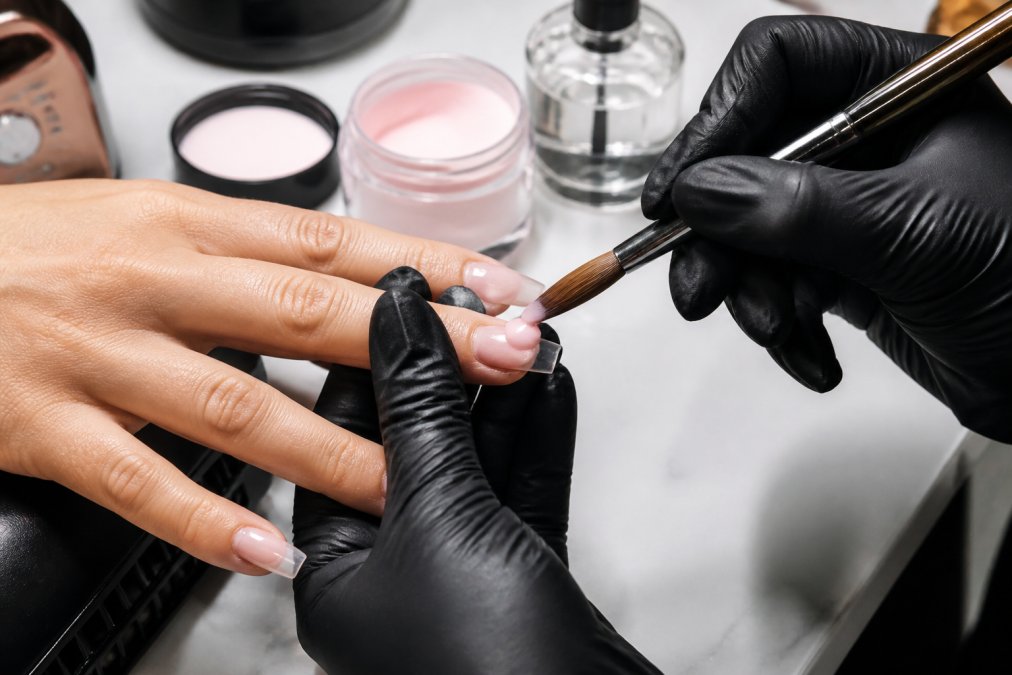
Monomer consistency matters as much as the powder. A low-odor monomer with balanced evaporation helps pink powder self-level and reduces air bubbles. JBB Nail’D It products are formulated to work together for predictable results.
The Bead Consistency Sweet Spot
Most application failures trace back to bead consistency. A properly mixed bead should hold a glossy, dome-shaped appearance for 3 to 5 seconds (peer-reviewed research). A dull, crumbly bead has too much powder; a dripping bead is too wet, extending cure time and risking product sinking into the cuticle.
Touch the bead with the side of your monomer-dipped brush; it should feel tacky but not sticky. This window lasts 8 to 12 seconds with standard monomer, extending to 15 seconds with low-odor formulas.
Zone-Based Placement for Pink Overlays
Professional techs divide the nail into three zones, cuticle, center, and free edge, placing separate beads. The cuticle zone needs the thinnest layer (about half a credit card's thickness), the center supports the apex, and the free edge gets a slightly thicker layer to prevent tip lifting.
With sheer pink, place the cuticle bead first and pat it toward the center, dragging creates streaks that are hard to file out. Opaque pinks are more forgiving but amplify sidewall unevenness, so keep brush strokes parallel to the nail bed.
Timing Your File Work
Pink acrylic cures in stages. Within 2 to 3 minutes, the product should feel firm but slightly flexible, the ideal window for shaping. After 5 minutes it reaches full hardness; filing before gums up the file, filing after risks removing too much product.
Over-filing sheer pink thins the overlay and creates chalkiness. Use a 180-grit file with light pressure, checking every three strokes. If unevenness persists, the issue is bead placement, remove and reapply rather than compromising thickness.
Monomer Evaporation and Room Conditions
Salon environment affects pink acrylic behavior. Humidity above 60% slows monomer evaporation, making beads wetter; below 30% causes dry, crumbly beads (the CDC). Most monomers are formulated for 40% to 50% humidity, so adjust bead size: slightly wetter in dry conditions, drier in humid ones.
Cold monomer (below 65°F) thickens and reduces working time; warm monomer (above 80°F) thins and runs (osha.gov). Store at room temperature away from heat or AC vents. In dry climates, some techs add one drop of monomer to the powder well before mixing.
Avoiding the Most Common Pink-Specific Failure: Chalkiness
Chalkiness in pink acrylic is almost always a filing problem. Pink pigments sit closer to the surface, so aggressive filing exposes the polymer matrix. Use a 240-grit file for final smoothing and finish with a 3-way buffer. Chalkiness after the client leaves usually means the overlay was filed thinner than 0.5 mm.
A secondary cause is a bead that is too dry, creating microscopic air pockets. If the finish is dull immediately after curing, remix with a wetter bead and reapply rather than polishing out the issue.
The Best Pink Acrylic Powder for Beginners: What to Look For
The best pink acrylic powder for beginners prioritizes forgiveness over speed, a formula that stays workable long enough to shape but cures firmly enough to file.
Look for these characteristics when selecting your first pink powder:
- Consistent pigment distribution. The color should be uniform throughout the powder, with no streaking or patchiness when mixed with monomer.
- Predictable working time. A powder that sets too fast creates panic; one that takes too long wastes time. Mid-range working times suit most learning curves.
- Low dust and odor. Professional-grade acrylic polymer should not produce excessive dust when filing or an overpowering smell during application.
- Reliable adhesion. The powder should bond cleanly to the natural nail with proper prep, without lifting at the edges within the first week.
Professional-grade pink powder is not overkill for weekend home techs, it removes variables that cheap products introduce, meaning fewer failed sets and less wasted product while practicing.
Matching Pink Powder to Skin Tones and Nail Shapes
Pink acrylic powder should complement the client's skin tone. Fair skin suits cooler, blue-based pinks; warmer, peachier pinks flatter medium and olive undertones; deeper skin tones look best with richer, more saturated pinks.
Nail shape also influences how color reads. Shorter, squoval nails suit brighter pinks; long almond or stiletto shapes carry softer, sheerer shades. Testing a small bead on the natural nail before a full set is the fastest way to confirm the shade.
Spring and summer favor lighter, brighter pinks; autumn and winter lean into deeper berry tones. Keeping a range of shades lets you match both skin tone and season without mixing custom pigments.
Undertone Analysis Beyond Simple Categories
Skin tone matching fails when you rely on broad categories without examining undertones. A fair-skinned client with warm undertones looks sallow in a blue-based pink, while a deep-skinned client with cool undertones can carry bright, cool pinks.
Examine the veins on the inside of the client's wrist in natural daylight. Blue or purple veins indicate cool undertones; green or olive indicate warm; a mix suggests neutral. Cool undertones pair with blue- or lavender-based pinks ("ballet pink" or "baby pink"), warm with yellow- or peach-based pinks ("peachy pink" or "shell pink"), and neutral undertones carry most shades but look best in true pinks.
Pink Shade Families and Their Effects
Professional pink acrylic powders fall into several distinct shade families, each with a different visual effect on the nail:
- Sheer blush pinks (e.g., "natural pink," "soft pink"): Semi-translucent, these mimic the natural nail bed and are ideal for overlays on healthy nails. They read as "no polish" or "clean girl" aesthetics.
- Opaque ballet pinks (e.g., "French pink," "ballerina"): Full coverage with a cool, slightly blue undertone. These suit French manicures and clients who want a polished, classic look.
- Warm peach pinks (e.g., "apricot pink," "sunset"): Contain yellow or orange pigments that warm the complexion. Best for warm undertones and summer sets.
- Dusty rose pinks (e.g., "mauve pink," "rose gold"): Muted with gray or brown undertones. These flatter medium and olive skin tones and work year-round.
- Hot or fuchsia pinks (e.g., "neon pink," "magenta"): High saturation, often opaque. These make a statement and suit deeper skin tones or clients who want bold color.
The 3-Zone Color Test
Before committing to a full set, perform a 3-zone test: apply a small bead to the cuticle area, center, and free edge, then cure and file. Examine in natural daylight and salon lighting. Pink pigments shift with overlay thickness and natural nail color, so a shade that looks perfect in the jar may appear too pale or too bright once applied.
This test is especially important for sheer pinks. Clients with yellowed or stained nails need an opaque pink or whitening base coat beneath a sheer overlay, or the final color will look muddy.
Seasonal and Occasion-Based Pink Selection
Occasion and season also influence shade choice. Bridal sets favor sheer blush or opaque ballet pinks that photograph well; prom or formal events suit deeper pinks like dusty rose or magenta. Summer favors brighter, warmer pinks; winter leans into cooler, deeper berry tones.
A practical seasonal guide for your consultation:
- Spring (March-May): Sheer blush, soft pink, light peach
- Summer (June-August): Bright pink, coral pink, hot pink
- Fall (September-November): Dusty rose, mauve, berry pink
- Winter (December-February): Ballet pink, cool pink, deep rose
Nail Shape and Pink Perception
Nail shape changes how pink reads by altering the ratio of color to skin. Short, wide nails benefit from brighter, more saturated pinks that create the illusion of length. Long, narrow nails can carry sheerer or lighter pinks because the extended nail bed provides more surface area.
For very short nails (under 1/4 inch past the fingertip), opaque pinks in medium saturation look most natural, pale pinks can look dirty, neon pinks overwhelm. Medium-length nails (1/4 to 1/2 inch) handle the full range, while long nails (over 1/2 inch) should avoid overly dark pinks that look heavy.
Troubleshooting Common Pink Powder Problems
Pink powder issues trace back to bead consistency, nail prep, or product quality. Here's how to fix the most common failures:
| Problem | Likely Cause | Fix |
|---|---|---|
| Lifting within days | Inadequate nail prep or primer | Re-buff the nail plate and reapply dehydrator and primer before the next set |
| Chalky or dull finish | Bead too dry or powder over-filed | Use a wetter bead and stop filing once the surface is smooth |
| Air bubbles in the acrylic | Mixing too vigorously or stale monomer | Stir gently and check monomer freshness |
| Color streaking | Poor pigment distribution in the powder | Switch to a professional-grade powder with consistent pigment density |
Lifting damages reputations fastest. If a client returns with lifted pink powder within two weeks, the issue is almost always prep-related. Natural nail oils and moisture are the enemy of adhesion, making dehydrator and primer non-negotiable.
Caring for Your Pink Acrylics to Extend Wear
Clients who care for their pink acrylics between appointments get significantly more wear from each set. The routine is simple, but consistency matters more than effort.
Daily care means keeping nails dry and cuticles moisturized. Water under the free edge causes lifting, so advise gloves for dishes and cleaning. Daily cuticle oil prevents the acrylic from looking dry and dull.
Removal also affects future sets. Pink acrylic should be soaked off with pure acetone, never pried off. Rushing removal damages the natural nail plate, compromising the next set's adhesion.
Final Thoughts on Choosing Your Pink Powder
Pink powder is a foundational product that rewards careful selection and disciplined technique. The right pink acrylic powder makes the difference between sets that last and sets that disappoint.
At JBB Nail’D It, we formulate our acrylic powders for consistent performance, from pigment density to working time, so you can focus on your craft rather than fighting your materials. Our professional-grade pink powder options suit both beginners learning the basics and experienced techs who demand reliable results on every set.
Frequently Asked Questions
What is the difference between sheer and opaque pink acrylic powder?
Sheer pink acrylic powder is semi-translucent, allowing the natural nail bed to show through for a subtle, 'my nails but better' look. Opaque pink powder provides full, solid color coverage, hiding any natural nail discoloration. Your choice depends on the desired effect: sheer works well for natural overlays and French manicures, while opaque is ideal for full coverage sets or when you want the pink shade to be the star of the design.
Is pink acrylic powder better for French manicures?
Yes, pink powder is essential for French manicures. Sheer pink shades create the classic, natural-looking base that mimics a healthy nail bed, providing the perfect canvas for white tips. For a modern twist, you can use a more opaque or brighter pink for a colorful French set. The key is selecting a pink that complements your client's skin tone to achieve a seamless, polished finish.
How do I choose the right pink powder for different skin tones?
For fair skin, cool-toned or soft baby pinks look natural. Medium skin tones are flattered by rose or dusty pinks. Deeper skin tones shine with vibrant, fuchsia, or berry-toned pinks. The goal is to pick a shade with the same undertone as the client's skin to create a seamless, flattering extension of the nail bed. When in doubt, hold the powder jar against the client's finger to test the color.
What does the pink powder do in an acrylic set?
In an acrylic set, pink powder serves as the primary sculpting medium for the nail bed and the main body of the enhancement. It provides the structure, strength, and color base over which the clear powder or white tips are applied. This pink base creates the illusion of a natural, healthy nail, giving the final set a realistic and polished appearance while providing the durable foundation for the nail extension.
Choosing the right pink powder comes down to understanding finishes, matching skin tones, and mastering application fundamentals. JBB Nail’D It offers high-performance acrylic powders designed to deliver flawless, durable results, backed by a mission to support nail professionals from students to seasoned salon experts. Get started with JBB Nail’D It and build a pink powder collection that performs as hard as you do.