


Last Updated: November 1, 2026
Quick Summary
Professional grade acrylic powder gives nail techs stronger, more durable sets that resist lifting and chipping, with predictable bead control that speeds up work. It is finely milled and consistent in color, which makes results repeatable across services and techs. Pairing it with the matched monomer ratio is what lets those benefits hold up on clients' nails.
- Strength and durability matter most on thin natural nails and on tips with a stressed free edge.
- A narrow particle-size range keeps the liquid-to-powder ratio predictable from bead to bead.
- Choose powders whose listings mention adhesion and minimal lifting, and prep nails thoroughly.
- Use the monomer the brand recommends, since mismatched systems can clump, cure slowly or weaken edges.
- Test a 1 oz Sample Acrylic Powder at $10.00 before buying full-size stock.
Table of Contents
- What Makes an Acrylic Powder Professional Grade
- 1. Greater Strength and Durability on Natural Nails and Tips
- 2. Smoother Consistency and Easier Bead Control
- 3. Better Adhesion With Fewer Lifts and Chips
- 4. Reliable Results When Paired With the Right Monomer Ratio
- 5. Versatility for Sculpting, French Sets and Nail Art
- 6. A Suitable Starting Point for Beginners Building Skill
- 7. Consistent Performance Across Services for Salons
- Watch Out: Storage and Handling Affect Results
- Choosing the Right Professional Powder
- Frequently Asked Questions
Choosing professional grade acrylic powder is the difference between a set that lasts two weeks and one that lifts by day five. If you are a nail tech choosing supplies for your salon or your own bench, the powder you pick shapes how your work holds up, how fast you can move, and how much your clients come back. JBB Nail'D It builds its acrylic powders for nail techs first, so this guide walks through seven concrete benefits of using professional-grade powder, and what to look for when you compare options.
Quick Picks:
- Best for everyday salon sets: Cover Pink, a blush-toned powder built for full coverage and sculpting
- Best for clear work: Translucent, for encapsulations, glass designs and clear bases
- Best for trying before you commit: JBB Nail'D It Sample Acrylic Powder, a 1 oz jar at $10.00
What Makes an Acrylic Powder Professional Grade
Professional-grade acrylic powder is formulated for repeated salon use, not occasional home projects. The term describes how the powder is milled, how it flows and how it bonds under daily service conditions.
In practice, a professional-grade powder usually shows three traits: a finely milled texture, predictable bead behavior, and consistent color from one jar to the next. JBB describes its Cover Pink powder as a finely milled formula that delivers strong adhesion, easy bead control and a smooth, self-leveling application with minimal lifting.
A common mistake is judging a powder only by its color chart. Two powders can look identical in the jar and behave very differently on the nail. Look at the product description for specifics such as adhesion, bead control and finish, not just shade names.
1. Greater Strength and Durability on Natural Nails and Tips
Strength is the benefit most techs notice first when they switch to professional grade acrylic powder. A powder that bonds well and cures evenly gives a set more structure, which matters most on thin natural nails and on tips where the free edge takes daily stress.
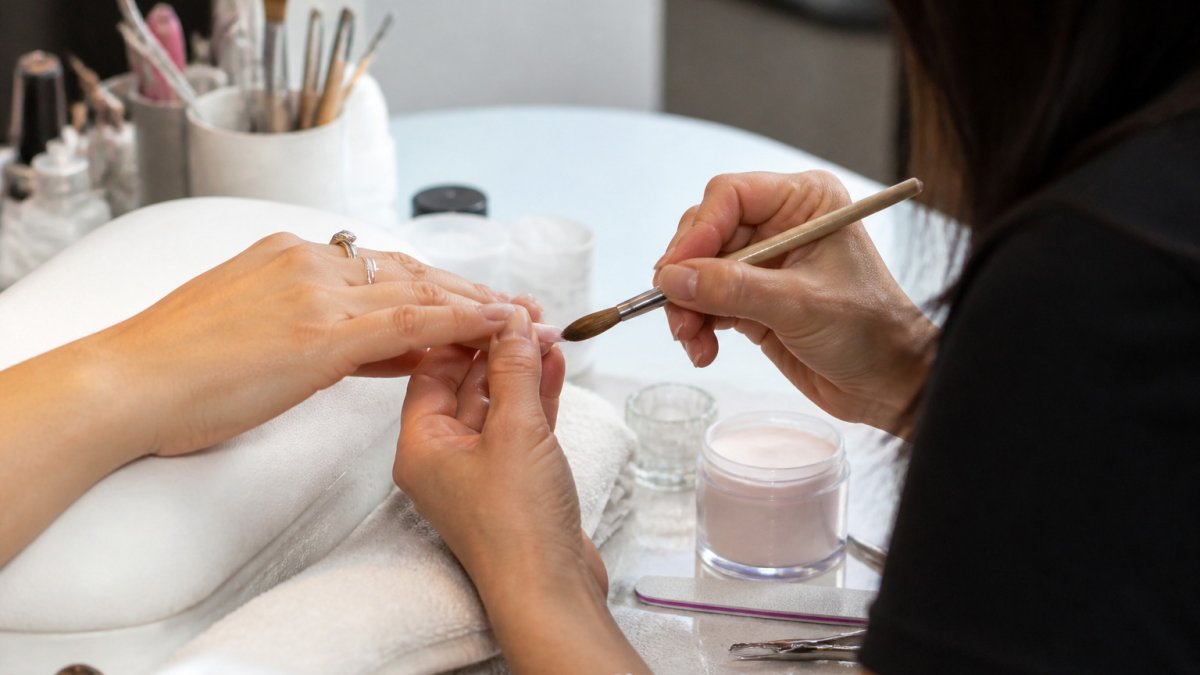
JBB's Accelerated Formula Monomer, for example, is described as maintaining exceptional adhesion, strength and durability at a faster working time. Pairing a durable powder with a matched monomer is how you get that strength in practice.
2. Smoother Consistency and Easier Bead Control
Bead control is the skill that separates a clean set from a filing marathon. A professional-grade powder is milled to a narrow particle-size range, so when you dip your brush the liquid-to-powder ratio stays predictable from bead to bead. That predictability is what lets you place the apex, pinch the sidewalls, and build structure without chasing runny product or fighting a stiff ball that will not level.
What "good" bead behavior looks like in practice:
- Pickup: The bead releases from the brush in one piece and holds a rounded shape instead of splitting or dripping.
- Working time: You get enough seconds to pat the bead into place and shape the smile line before it sets. Working time varies by brand and monomer, so check the manufacturer's guidance for the product you use.
- Self-leveling: The bead flows slightly after placement, filling minor pits and ridges so you file less and keep more of the apex intact.
- Set: The surface loses its tack and stops moving without shrinking or pulling away from the sidewalls.
If your bead turns runny or stiff within a minute or two, the cause is usually one of three things: the powder-to-liquid ratio is off, the monomer is evaporating because the dappen dish has been open too long, or the room is unusually warm or cold. Temperature is often a variable in bead behavior, so keeping your station within the manufacturer's recommended working range can help stabilize results.
Why this matters for your bench: predictable beads cut filing time, reduce the risk of over-filing the natural nail, and make your service times consistent across clients. For a faster-setting option built for busy benches, see the JBB Nail'D It Accelerated Formula Monomer, which is engineered for controlled working time in high-volume salons.

3. Better Adhesion With Fewer Lifts and Chips
Lifting is the complaint that brings clients back early. Good adhesion starts with clean, dehydrated nail preparation, and then depends on the powder bonding firmly to the monomer and the natural plate.
Pick powders whose listings specifically mention adhesion and minimal lifting. The Cover Pink listing, for instance, cites strong adhesion with minimal lifting, which is the outcome you want on every service. Prep the nail thoroughly before you apply, because no powder can fully compensate for oily or poorly prepped surfaces.
4. Reliable Results When Paired With the Right Monomer Ratio
Acrylic powder and monomer are a two-part system, and the ratio you mix them in decides how the set cures, how strong it is, and how long it lasts. The powder is a polymer; the monomer is a liquid monomer that softens and binds the polymer particles, then cures into a solid. If the ratio is off, the cure is off, and no amount of filing or top coat will fix it.
What goes wrong when the ratio or pairing is wrong:
- Too wet: The bead runs, pools in the sidewalls, and cures with shrinkage that pulls the product away from the natural nail, which is a common path to lifting.
- Too dry: The bead is stiff, does not self-level, and leaves air pockets or a chalky, brittle finish that chips at the free edge.
- Mismatched systems: Mixing one brand's powder with another brand's monomer can cause clumping, slow or incomplete cure, and weak edges, because each brand tunes its liquid to its own powder's particle size and chemistry.
Use the monomer the brand recommends for the powder you are running, and keep your ratio consistent across services. The JBB Nail'D It Standard Monomer is formulated for extended working time, which gives more room for precise bead placement on sculpted sets and intricate art. The Advanced Formula Monomer offers balanced working time for everyday full sets and fills. Matching your monomer to your workflow is what makes results repeatable.
A practical ratio check: a medium bead should look like a small, glossy ball that holds its shape on the brush and settles slowly on the nail. If it drips off the brush, you are too wet; if it crumbles at the edges, you are too dry. Most techs find their ratio by feel within a few services, but writing down the dish-to-powder scoop you used for a set that cured well gives you a baseline to return to.
Finally, set realistic expectations with clients: a well-matched system gives durable wear, but it still needs fills every two to three weeks and proper removal to protect the natural nail. Durability is not the same as damage-free or maintenance-free, and telling clients that up front protects both their nails and your rebooking rate.
5. Versatility for Sculpting, French Sets and Nail Art
Professional-grade powder should work across sculpted sets, French tips, soft sets and nail art, without changing how you apply it. Color range matters here, because the right base shade makes each style look intentional.
Cover Pink is designed for sculpting nail beds, French manicures and natural acrylic sets. Translucent suits encapsulations and glass designs, and Nude 101 is a soft beige that works well for French tips and sculpted sets. Choosing the base that fits the design keeps your finish clean without extra coats.
6. A Suitable Starting Point for Beginners Building Skill
Beginners often assume professional powder is too demanding. In reality, a well-milled, predictable powder can be easier to learn on, because it behaves consistently and gives fewer surprises while you build technique.
The JBB Nail'D It Sample Acrylic Powder, a 1 oz jar at $10.00, lets students and new techs test a formula before buying a full size. Beginners can also explore the Tasha soft rose pink powder, which is easy to apply for practice. Consistent results make it easier to tell whether a problem is your technique or your product.
7. Consistent Performance Across Services for Salons
For salons, the real value of professional-grade powder is repeatability. When every tech gets the same flow, color and cure from the same product, service times and client results become predictable.
Salon owners should look at consistency across the whole menu, from quick fills to full sets. Consistency across techs is what protects client satisfaction over time.
Watch Out: Storage and Handling Affect Results
Keep powder jars sealed and away from heat and moisture, since both can change how the powder flows. Keep the monomer tightly capped too, because evaporation alters the ratio you tested.
Choosing the Right Professional Powder
Start with your most common service. If you run mostly full sets, prioritize adhesion and a monomer that matches your working time. If you do lots of art, prioritize shade range and bead control. Test a small jar before committing to bulk stock.
Choose the powder that fits your daily service mix, paired with a monomer you can rely on every time. Browse the full JBB Nail'D It range to find the match for your bench.
The table below sums up how to match a powder to your service mix, using the options the article names.
| Your main service | Priority | Product the article names |
|---|---|---|
| Everyday salon sets | Adhesion and coverage | Cover Pink |
| Clear work and encapsulations | Clear finish | Translucent |
| Trying before you commit | Low-cost test | JBB Nail'D It Sample Acrylic Powder, 1 oz, $10.00 |
| Sculpted sets and intricate art | Extended working time | Standard Monomer |
| Everyday full sets and fills | Balanced working time | Advanced Formula Monomer |
| Busy high-volume benches | Controlled working time | Accelerated Formula Monomer |
Frequently Asked Questions
What is professional-grade acrylic powder?
Professional-grade acrylic powder is a finely milled, consistent powder formulated for salon work, where it is mixed with monomer to form strong, sculptable enhancements. Compared with basic powders, it is designed for smoother bead control, self-leveling application and dependable adhesion across repeated services. JBB Nail’D It describes its See Thru, Translucent, Cover Pink, Snow Bunny, Nude 101 and Bubblegum powders as premium, professional-grade formulas, so check each listing for its specific characteristics before choosing one for a service.
Can beginners use professional-grade acrylic powder?
Yes. Professional-grade powder is not reserved for experienced technicians. Beginners often benefit from a consistent powder because it behaves more predictably during bead placement, which makes practice easier to track. JBB Nail’D It lists its Cover Pink powder as suitable for beginner and professional technicians, and its Sample Acrylic Powder is a low-commitment option for trying a formula before buying a full jar. Pair any powder with a monomer that suits your working speed.
Does acrylic powder quality affect how long enhancements last?
Powder quality is one factor in how long an enhancement holds, alongside preparation, application technique and aftercare. A finely milled powder with strong adhesion tends to reduce lifting and chipping when the surface is properly prepped and the bead is placed cleanly. Technicians should still follow careful prep steps, such as dehydrating the nail and removing shine, because no powder can compensate for a poorly prepared nail surface.
